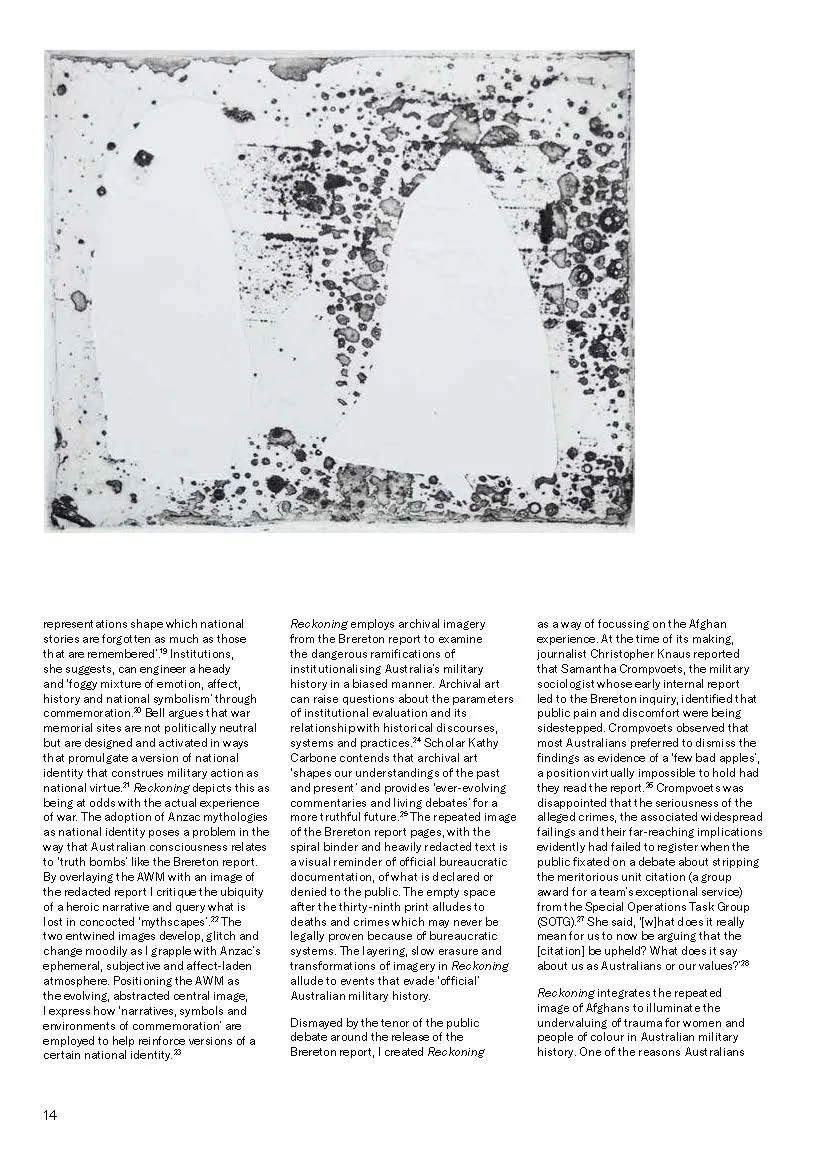
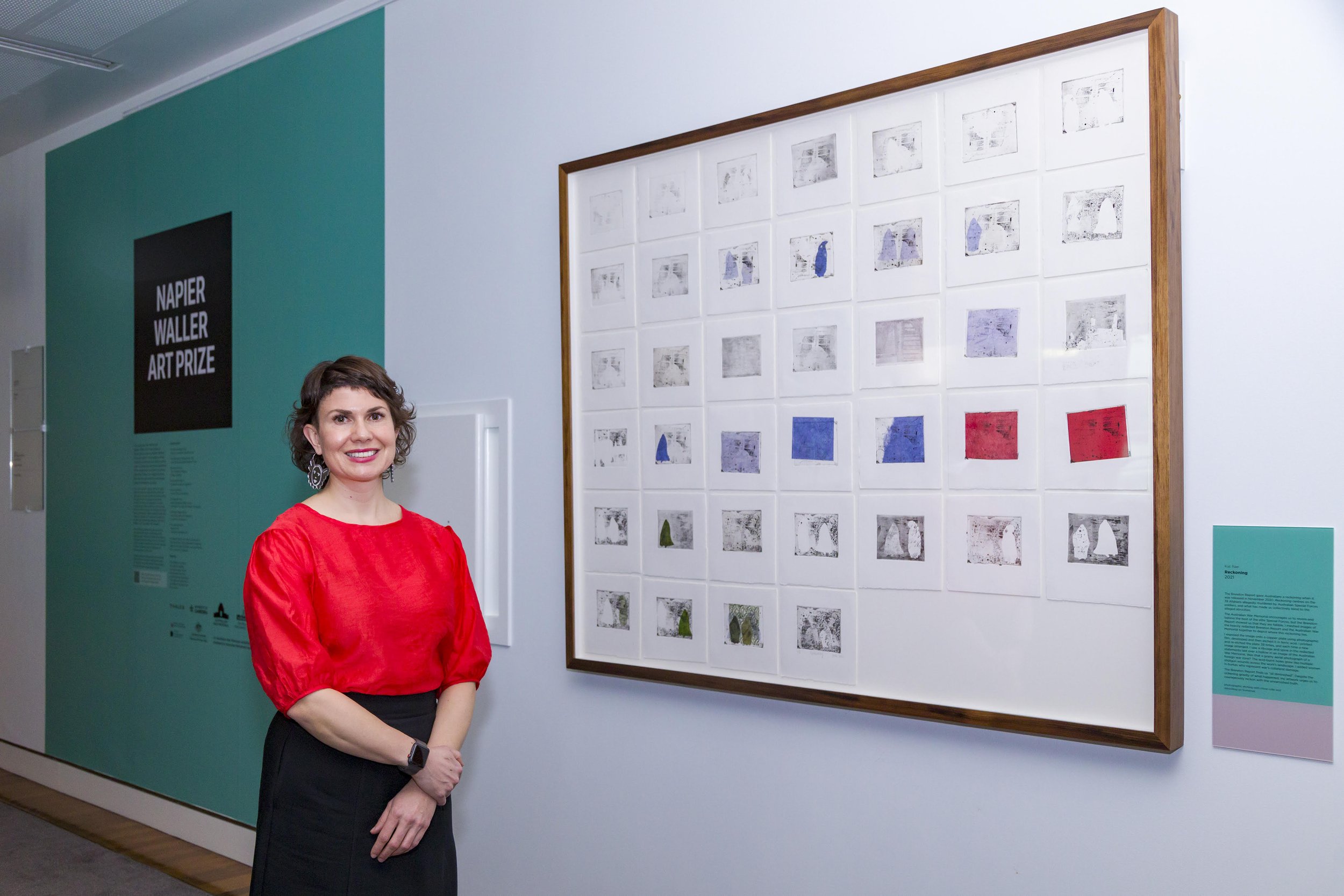
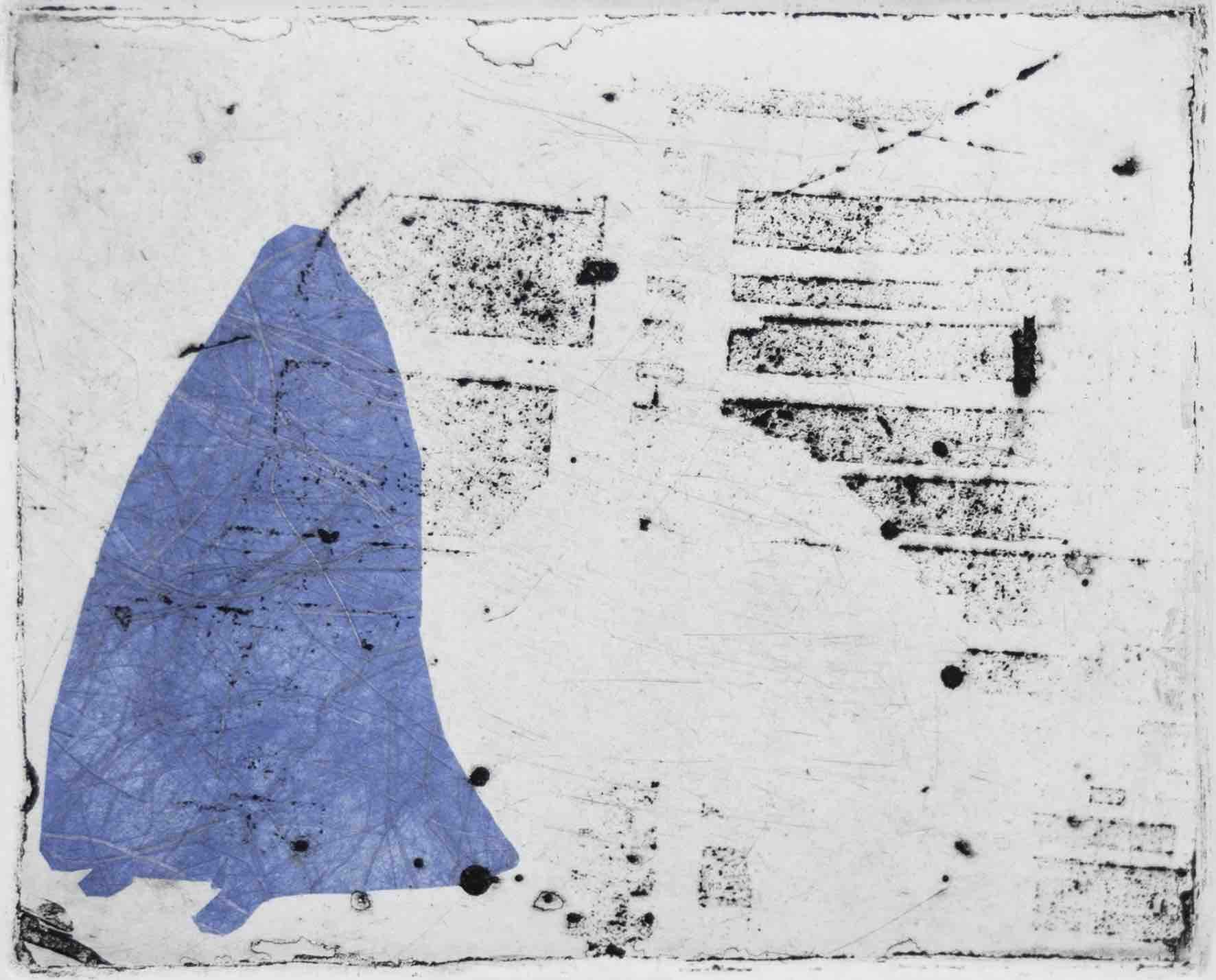
Reckoning
Highly commended in the 2022 Napier Waller Art Prize
Displayed in the new Afghanistan War Galleries at the Australian War Memorial, Canberra
2021
photographic etching with chine colle and stencilling on Somerset
140 x 120 cm
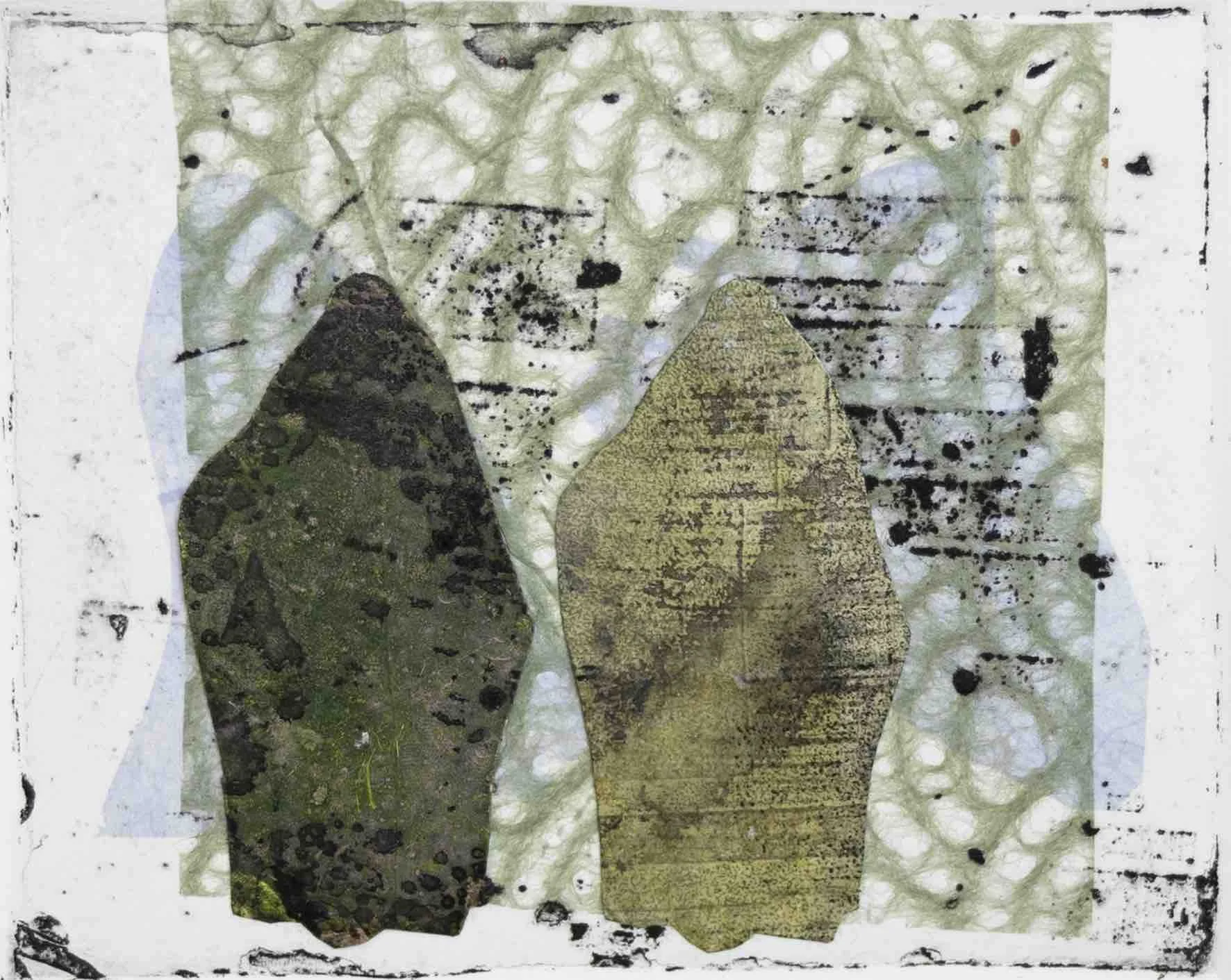
The Brereton Report gave Australians a reckoning when it was released in November 2020. Reckoning centres on the 39 Afghans allegedly murdered by Australian Special Forces soldiers, and what has made us ‘collectively blind’ to the alleged atrocities.
The Australian War Memorial encourages us to revere and believe the best of the elite Special Forces, but the Brereton Report showed us that they are fallible. I meshed images of the heavily redacted Brereton Report and the Australian War Memorial together to depict where this reckoning lies.
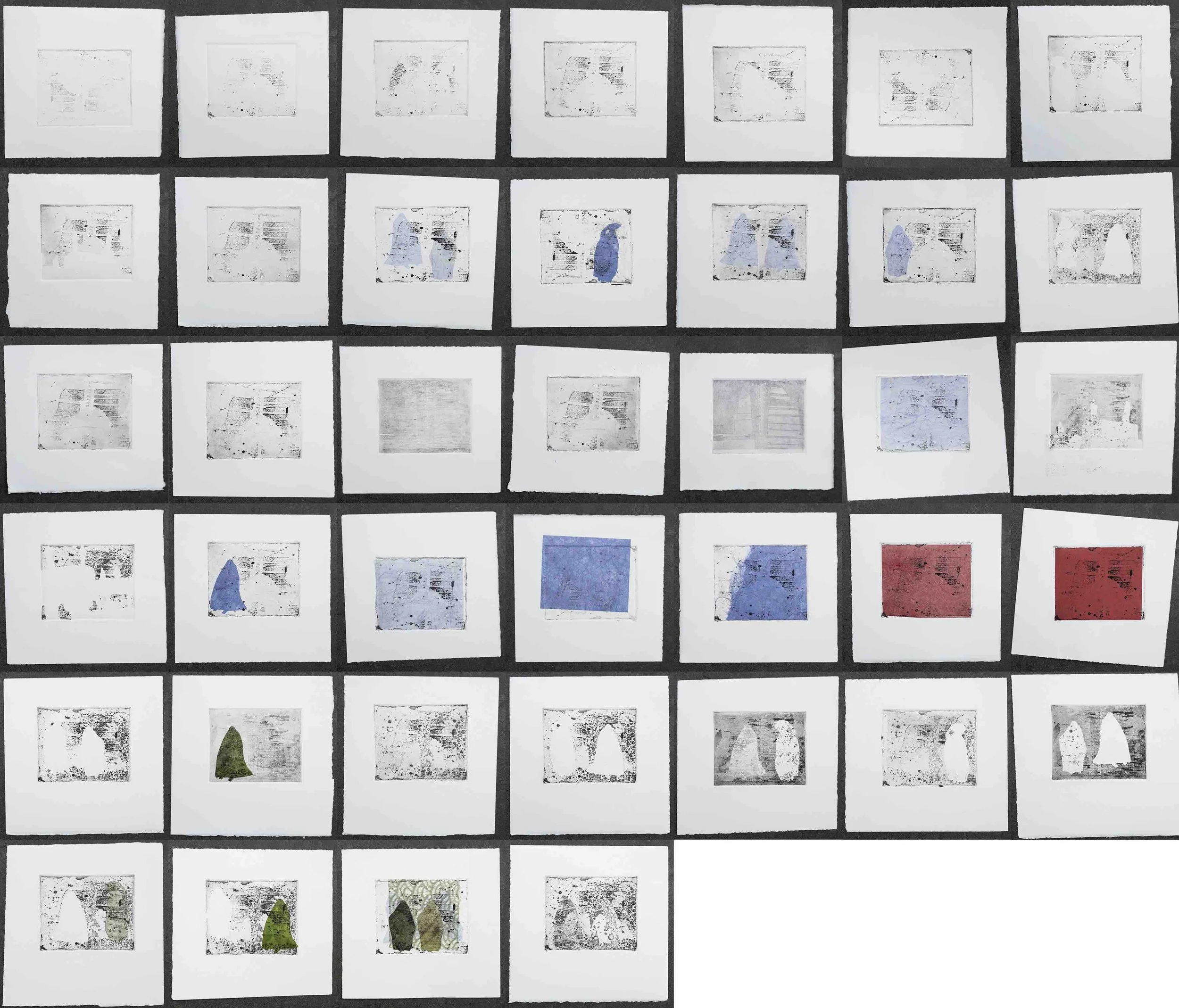
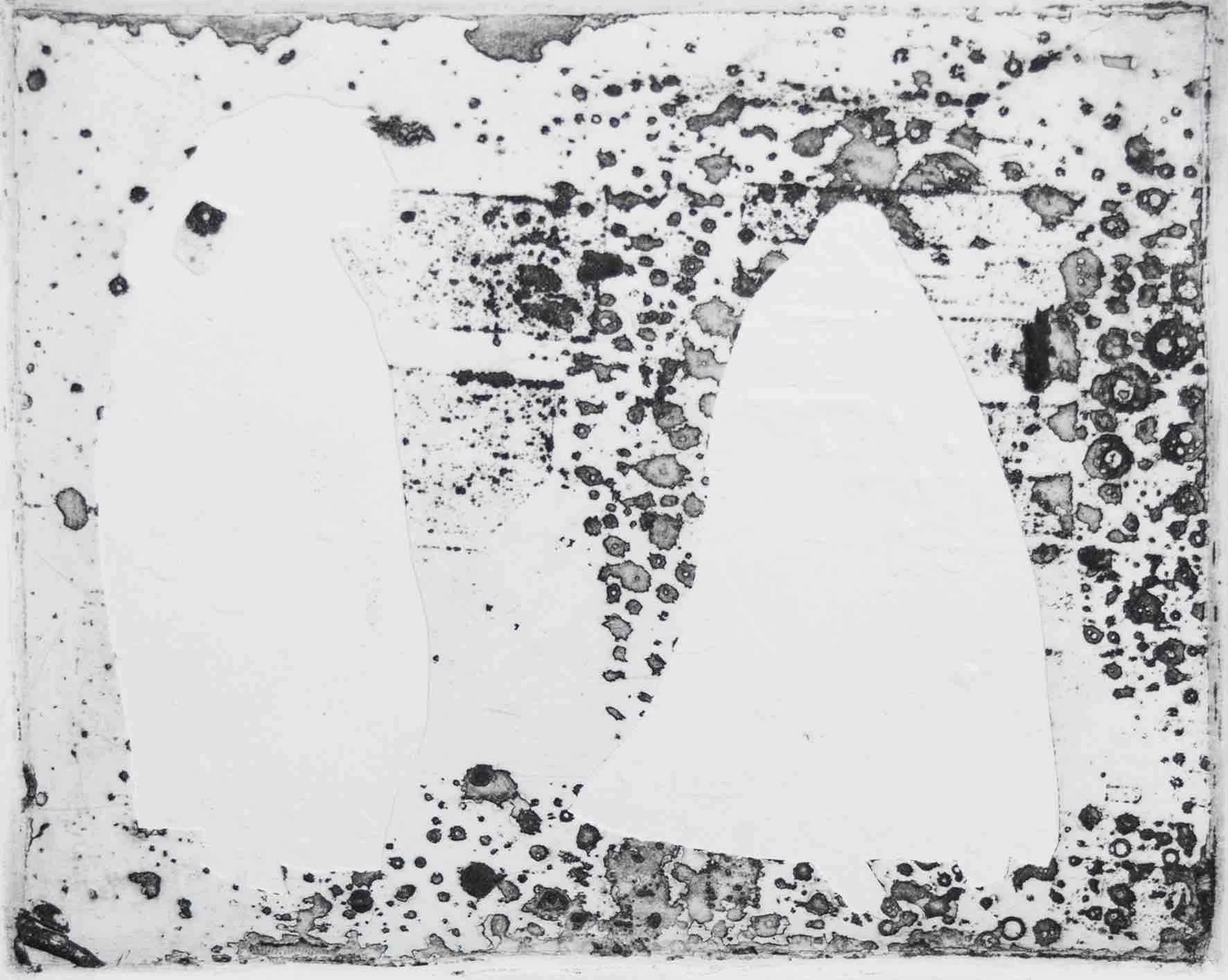
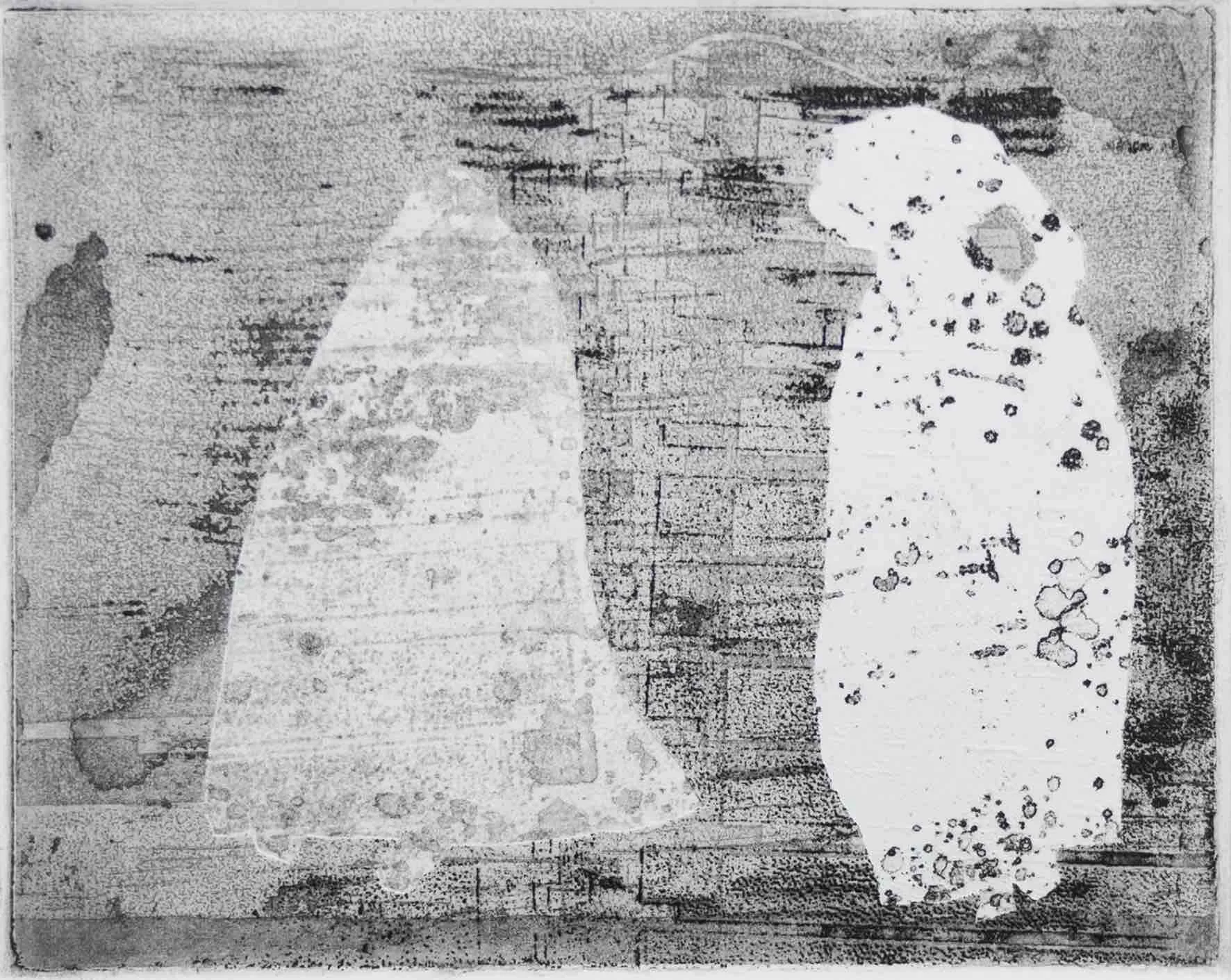
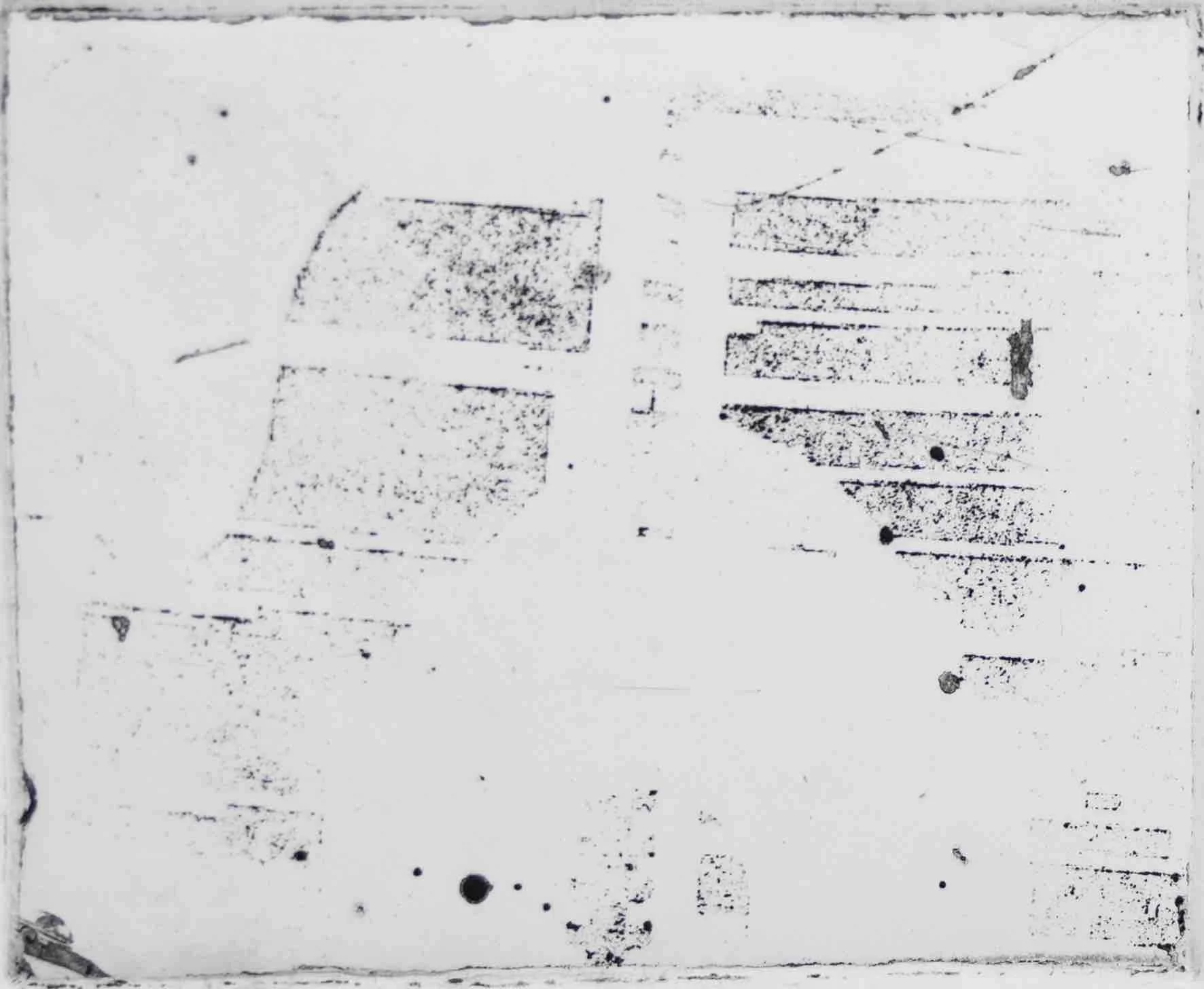
I exposed the image onto a copper plate using photographic film, developed and then etched it in ferric acid. I printed and re-etched the plate 39 times, and each time a new image emerged. I saw a ribcage and spine in the redacted statements laid over a hollow in an image of the Australian War Memorial. Was that a grainy aerial photograph of a foreign war zone? The acid-burnt holes grew like multiple shotgun wounds across the work’s landscape. I added women in burkas who represent war’s ‘collateral damage’.
The Brereton Report finds us ‘all diminished’. Despite the sickening gravity of what happened, my artwork urges us to courageously reckon with the unvarnished truth.
In what ways can print practice be used to promote thought on uncomfortable Australian military history?
Kat Rae
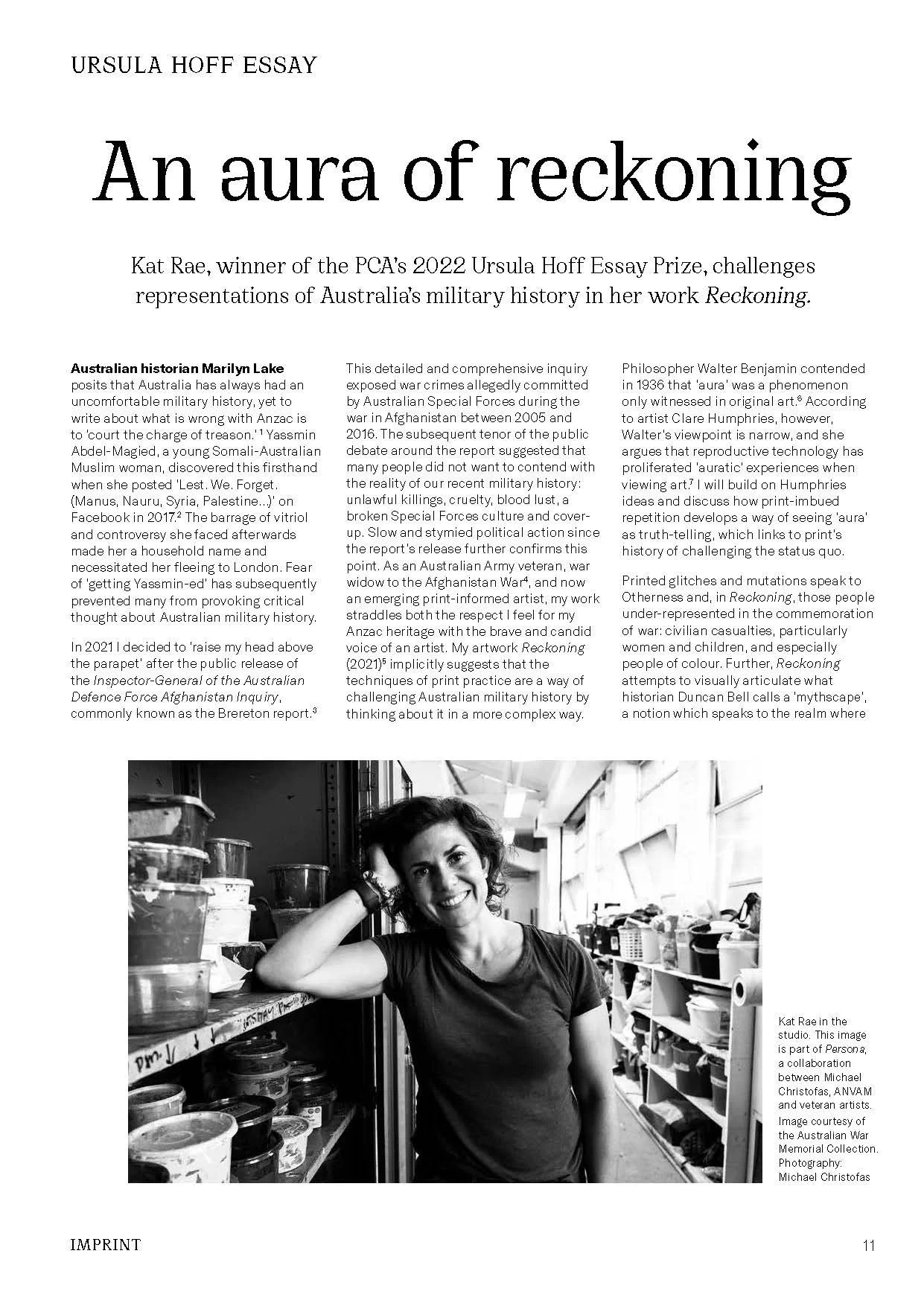
Australian historian Marilyn Lake posits that Australia has always had an uncomfortable military history, yet to write about what is wrong with Anzac is to court the charge of treason (Lake 2010). Yassmin Abdel-Magied, a young Somali-Australian Muslim woman, discovered this firsthand when she posted ‘Lest. We. Forget. (Manus, Nauru, Syria, Palestine …)’ on Facebook in 2017 (Msimang 2022). The barrage of vitriol and controversy she faced afterwards made her a household name and necessitated her fleeing to London. Fear of 'getting Yassmin-ed' has subsequently prevented many from provoking critical thought about Australian military history.
In 2021 however, I decided to ‘raise my head above the parapet’ after the public release of the Inspector-General of the Australian Defence Force Afghanistan Inquiry Report, commonly known as the Brereton Report. This detailed and comprehensive inquiry exposed war crimes allegedly committed by Australian Special Forces during the war in Afghanistan between 2005 and 2016. The subsequent tenor of the public debate around the report suggested that most people did not want to contend with the reality of our recent military history: unlawful killings, cruelty, blood lust, a broken Special Forces culture and cover-up. Slow and stymied political action since the report’s release further confirms this point. As an Australian Army veteran and war widow to the Afghanistan War, and now an emerging print artist, my work straddles both the respect I feel for my Anzac heritage with the brave and candid voice of an artist. My artwork Reckoning (figure 1) illustrates how print practice promotes complex thinking about challenging Australian military history. Print-imbued repetition and ritual develops an ‘aura’ of truth telling and links to the medium’s history of challenging the status quo. Printed glitches and mutations speak to Otherness, and namely in Reckoning, those underrepresented in the commemoration of war: civilian collateral damage, particularly women and children – and especially people of colour. Further, though developing printerly atmospherics related to site and commemoration, staged affect and imagined memory can hinder us from addressing fact and history. Such ‘fact and history’ is officially documented through traditional print, but contemporary print can point to the fallibility and bias of archive, and how it shapes and warps our understanding of reality. Print and trauma have adjacent conceptual ideas connected to their imbued processes, and futher, print relates to the trauma of the Other, and how its silencing prevents Australians from seeing the truth about our military history. Contemporary print can ask Australians to courageously reckon with the unvarnished truth of its military history, and in Reckoning’s case, it asks us to confront the gravity of the heavily redacted Brereton Report.
‘Aura’ not only refers to an artwork’s originality and authenticity, but also democratic truth telling evidenced in print, and explicitly in this essay, Reckoning. Philosopher Walter Benjamin’s argument that the ‘aura’ of original art is lost through reproduction is contested by contemporary print artists (Benjamin 1935). Artist Clare Humphries writes that print as a repetitive and ritualistic practice ‘changes the relations between audience and image’ and provides a more flexible reading of how Benjamin sees aura as ‘bringing the distant close.’ (Humphries 2018, p. 159). Indeed, Benjamin acknowledges that the reproducibility of an artwork potentially democratises it, and in turn renders audiences themselves participants (Dimi 2018). The ritualistic reproductive print process of Reckoning courts a notion of truth telling as ‘aura.’ Reckoning consists of a series of 39 abstract photographic etchings, each one representing an Afghan civilian allegedly murdered by the Special Forces. The images develop over the series to depict a collage of the heavily redacted Brereton Report and the Australian War Memorial (AWM), suggesting this is where the ‘reckoning’ lies. The iconic AWM is Australia’s national site of Anzac commemoration based in Ngunnawal country, Canberra. It encourages us to revere the ‘elite’ Special Forces, but the author of the Brereton Report, senior Army Officer and Judge Major General Paul Bereton, shows us that they are fallible, and further, ‘we are all diminished’ by its findings (Brereton 2020, p. 42).
Benjamin had hoped that print as a new media might enable a new form of art criticism capable of challenging the status quo (Dimi 2018). Reckoning does this. In the making of Reckoning I exposed the collage onto a copper plate using photographic film, developed, and then etched the plate in ferric acid. I ritualistically printed and re-etched the plate 39 times, in the same way that only through persistent and thorough inquiry will the truth of the alleged crimes be reached. In this emergence of ‘aura as truth’, I aimed to alter the relationship between viewer and the image through the process of repeating and continued readability. Each etch and print saw a new image emerge. A ribcage and spine in the redacted statements laid over a hollow in an image of the AWM. A grainy aerial photograph of a foreign war zone. The acid-burnt holes grow like multiple shotgun wounds or cancer across the work’s landscape. By drawing the viewer intimately close to investigate and ask where they are positioned, print captures an aura of truth telling.
Reckoning utilises print to represent war’s forgotten ‘collateral damage’; the marginalised voices that do not fit into Australia’s nationalistic story. Artist Richard Harding argues that the embedded female nature of print’s reproductive matrix aligns it to Otherness (Harding 2018). I built upon the embedded references to the Afghan Other in Reckoning, through not simply the modality of print, but also ingratiating the glitch and ghost created by stencilling and chine colle. In her manifesto Glitch Feminism, author Legacy Russell discusses how the glitch and ghost is often dismissed as ‘an error, a mistake, a failure to function’ but it also represents a ‘true potential’ through a realisation embodied within the Other (2021, p. 17). By adding glitched images of Afghans, ghosted bodies sometimes defined only by a negative space or an abstracted trace which overruns the edge, I remember not only the 39 deaths, but allude to the likely deluge of undocumented collateral damage. Like Russell’s manifesto, for me, Reckoning is an ‘an activist prayer, a call to action’ (2021, p. 17), a hope that Australians empathise with the Other in the Brereton Report’s findings.
In her book ‘Consuming Anzac: the history of Australia’s most powerful brand’ historian Jo Hawkins writes that for the most part, modern Australian society has an imagined rather than lived experience of war[1] (Hawkins 2018) and the consequent mythologising of Anzac blinds Australians to the uncomfortable truth of potential war crimes. Through printed techniques, Reckoning challenges viewers to identify where a truthful history might lie. Scholar Shanti Sumartojo investigates the AWM as a ‘mythscape’ site, where ‘symbolic representations shape which national stories are forgotten as much as those that are remembered’ (Sumartojo 2016, p. 541). She writes about how institutions can engineer a heady and ‘foggy mixture of emotion, affect, history and national symbolism’ through commemoration (Sumartojo 2016, p. 541). Historian Duncan Bell argues that war memorial sites are not politically neutral but are designed and activated in ways that promulgate a version of national identity that construes military action as national virtue (Bell 2003). Reckoning depicts this being at odds with the actual experience of war. The adoption of Anzac as national identity poses a problem in the way that Australian consciousness relates to ‘truth bombs’ like the Brereton report. By overlaying the AWM with an image of the redacted Brereton report I critique the ubiquity of a heroic narrative and queries what we miss when we lose ourselves in concocted ‘mythscapes’ (Scates 2015). The two entwined images develop, glitch and change moodily as I grapple with Anzac’s ephemeral, subjective and affect-laden atmosphere. Positioning the AWM as the evolving, abstracted central image, expresses how ‘narratives, symbols and environments of commemoration’ are employed to help reinforce versions of a certain national identity (Sumartojo 2016, p. 545).
Through iterations of print, Reckoning utilises archive art to examine the dangerous ramifications of institutionalising Australia’s military history in a biased manner. Archival art is interested in examining the parameters of institutional evaluation and its relationship with historical discourses, systems and practices (Simon 2002). Scholar Kathy Carbone contends that archival art ‘shapes our understandings of the past and present’ and provides ‘ever-evolving commentaries and living debates’ for a more truthful future (Carbone 2020, p. 257). The repeated image of the Brereton report pages, with the spiral binder and heavily redacted text is a visual reminder of official bureaucratic documentation, of what is declared or denied to the public. The empty space after the 39th print alludes to deaths and crimes which may never be legally proven because of bureaucratic systems. The printerly layering, slow erasure and transformations in Reckoning allude to events that are never officialised and thus evade Australian military history.
My printing of Reckoning was my way to centre Afghan experience when I was dismayed at the tenor of the public debate around the release of the Brereton report.
At this time, journalist Christopher Knaus reported that Samantha Crompvoets, the military sociologist whose early internal report led to the Brereton inquiry, identified that public pain and discomfort were being sidestepped. Crompvoets observed that most Australians preferred to dismiss the findings as evidence of a ‘few bad apples’, a position virtually impossible to hold had they read the report (Knaus 2020). Crompvoets was disappointed that the seriousness of the alleged crimes, the associated widespread failings and their far-reaching implications evidently had failed to register when the public fixated on a debate about stripping the meritorious unit citation (a group award for a team’s exceptional service) from the Special Operations Task Group (SOTG) (Knaus 2020). She said, ‘[w]hat does it really mean for us to now be arguing that the [citation] be upheld? What does it say about us as Australians or our values? (Knaus 2020).
Reckoning integrates the repeated image of Afghans to illuminate the undervaluing of trauma for women and people of colour in Australian military history. One of the reasons we struggle to reconcile the alleged war crimes is because the Anzac myth has systematically erased the Other’s trauma. Every soldier statue memorial in every Australian town and suburb is testament to the supremacy of white and male suffering – the experiences of women, children and people of colour marginalised in its mass-produced masculine and anglicised form (Allen 2008). When it was suggested that the focal point of the Sydney War Memorial (built in 1934) should be a female figure representing Australia, the ensuing outcry led to its replacement by a naked male warrior (White 1981). In its early days, the Victorian Shrine of Remembrance’s Dawn Services actively excluded women (ABC documentary 2022). After a decline in Anzac interest, the 1980s saw the tradition undergo an astonishing revival with the marketed representation of the veteran as the traumatised war victim (Hawkins 2018). Historian Christina Twomey argues that ‘trauma bought an audience back to Anzac’ but this empathy came with only a superficial understanding of war’s cost (Twomey 2013, p. 106). In Reckoning, the Afghan figures are tainted with ink from ghosted AWM printing. Women stand with loads carried on their heads. They represent the collateral damage of war who barely rate a mention in the Brereton report.
Australians do not want to consider how, in the Brereton report, our traumatised heroes also torment others. Psychiatrist Dr Bessel Van der Kolk, wrote about how the Vietnam veterans he treated with post-traumatic stress disorder (PTSD) often traumatised others, namely, women and children (Van der Kolk 2014). In Reckoning I depict civilian women, identities withheld through the burkas they wear, and draw attention to the historically ignored trauma of women (Herman 1992). Feminist psychiatrist Dr Judith Herman identified that it was only after Vietnam combat veterans had legitimised PTSD that it became clear that the most common PTSD was seen in women in civilian life (Herman 1992). Herman contends that ‘there is a war between the sexes’, and women and children are the casualties (Herman 1992). In this way, Reckoning identifies another uncomfortable military history, albeit veiled, like the women in my prints.
Print processes adjacently relate the recovery of PTSD. In the making of Reckoning my copper plate was systematically exposed to the biting nature of ferric acid, and the subsequent process of printing illuminated surprising details and truth that I found a way to accept and integrate. In my experience, processing trauma comes from accommodating reality, not an idealised history or conjured myth. The inability for Australians to see past idealised myth and recognise real trauma has a tangible effect on Afghan victims. On his first day as Defence Minister, Peter Dutton made the popular decision to reinstate SOTG’s meritorious service citation, whilst there has still been no parliamentary discussion or public transparency about the six oversight reports stemming from the Brereton report (Hurst, 10 May 2022) and Afghan compensation payments are yet to be decided upon by the Australian Government (Hurst, 24 April 2022).
Art critic Robert Hughes once wrote, art gives us a way of mediating ‘between a sense of history and an experience of the world’ (1991). Reckoning calls into question Australia’s militaristic history through Benjamin’s aura of printerly democratic truth telling. It asks that we see the Other not only through the modality of print; the glitches in Reckoning provoke us to remember those forgotten in the primacy of the legends we valorise. Reckoning sets engineered ‘mythscapes’ in stark contrast to the real experiences of modern warfare. It contends with notions of the archive, questioning the place of official institutional memory. Reckoning challenges the reduction of Other’s suffering in the blinding commodification and dominance of white male war trauma. It argues that there are terrible ramifications for resisting the truth but through awareness Australians can reconcile the full spectrum of our military history. Only then will we begin to start growing into a nation not reliant on outdated myths to be proud.
[1] This is not to forget, of course, that we in Australia live in a landscape covered with sites of massacre from the colonising Frontier Wars. Historian Kate Rigby writes, ‘The First Nations Australians who were variously shot, poisoned and run off cliffs are now thought to total at least 100,000 (as many as all the Australians (some of whom were Aboriginal) who died in all foreign military engagements put together, and around 12 per cent of the estimated precontact population of 850,000 (representing some 700 language groups).' (Rigby 2020, p 8).
References
Allen, T 2008, Homesickness: Nationalism in Australian Visual Culture, Macmillan Art Publishing, Melbourne.
Australian Defence Force 2020, Inspector-General of the Australian Defence Force Afghanistan Inquiry Report (Brereton Report), Commonwealth of Australia, Canberra, <chrome-extension://efaidnbmnnnibpcajpcglclefindmkaj/https://afghanistaninquiry.defence.gov.au/sites/default/files/2020-11/IGADF-Afghanistan-Inquiry-Public-Release-Version.pdf>.
Araluen, E 2021. Drop Bear, University of Queensland Press, Brisbane.
Baguley, M, Kerby, M & Anderson, N 2021, ‘Counter Memorials and Counter Monuments in Australia’s Commemorative Landscape: A Systematic Literature Review’, Historical Encounters, vol. 8, iss. 3, pp. 93-120.
Bell, D 2003, ‘Mythscapes: memory, mythology, and national identity’, The British Journal of Sociology, vol. 54, iss. 1, pp. 63-81.
Benjamin, W 1935, The Work of Art in the Age of Mechanical Reproduction, Schocken Books, New York.
Bold, B 2007, ‘Material Thinking and the Agency of Matter’, Studies in Material Thinking, no. 1, vol. pp 1-4.
Brown, J 2014, Anzac’s Long Shadow – The cost of our National obsession, Redback, Sydney.
Carbone, K 2020, ‘Archival Art: Memory Practices, Interventions, and Productions’, Curator, vol. 63, pp. 257–263.
Conti, P 2022, Trauma: The Invisible Epidemic, Random House UK, London.
Dini, R 2018, An Analysis of Walter Benjamin’s the Work of Art in the Age of Mechanical Reproduction, Macat International Limited, London.
Grant, K 2017, All About Process: The Theory and Discourse of Modern Artistic Labor. University Park, The Pennsylvania State University Press, Pennsylvania.
Harding, R 2018, ‘Print as Other: the future is queer’, in R Pelzer-Montada (ed.), Perspectives of Contemporary Printmaking, Manchester University Press, Manchester, pp. 104-113.
Hawkins, J 2018, Consuming Anzac – The History of Australia’s Most Powerful Brand, University of Western Australia, Perth.
Herman, J 1992, Trauma and recovery, Basic Books, New York.
Hughes, R 1991, The Shock of the New, Thames and Hudson, Melbourne.
Humphries, C 2018. ‘Benjamin’s blindspot: aura and reproduction in the post-print age’, in R Pelzer-Montada (ed.), Perspectives of Contemporary Printmaking, Manchester University Press, Manchester, pp. 155-161.
Hurst, D 2022, ‘Australian Government misses compensation deadline for victims of alleged war crimes’, The Guardian, 24 April 2022, viewed 1 June 2022, <https://www.theguardian.com/australia-news/2022/apr/24/australian-government-misses-compensation-deadline-for-victims-of-alleged-war-crimes>.
Hurst, D 2022, ‘Peter Dutton’s department confirms defence minister has six Brereton oversight reports’, The Guardian, 10 May 2022, viewed 1 June 2022,
<https://www.theguardian.com/australia-news/2022/may/10/peter-duttons-department-confirms-defence-minister-has-six-brereton-oversight-reports>.
Inglis, K 2005, Sacred Places: War memorials in the Australian landscape, 5th edn, Melbourne University Press, Melbourne.
Knaus, C 2020, ‘Australians should not dismiss war crimes scandal as just a few 'bad apples', expert says’, The Guardian, 2 December 2020, viewed 30 May 2022,
<https://www.theguardian.com/australia-news/2020/dec/02/australians-should-not-dismiss-war-crimes-scandal-as-just-a-few-bad-apples-expert-says>.
Lake, M & Reynolds, H 2010, What’s Wrong with Anzac? University of New South Wales, Sydney.
McKenna, M 2021, ‘The Stunted Country’, The Monthly, 1 December 2021, viewed 7 June 2022, <https://www.themonthly.com.au/issue/2021/december/1638277200/mark-mckenna/stunted-country#mtr>.
Msimang, S 2022, ‘Will the hateful army who bullied Yassmin Abdel-Magied come after Australia’s diverse new parliamentarians?’ The Guardian, 5 June 2022, viewed 5 June 2022 < https://www.theguardian.com/commentisfree/2022/jun/05/will-the-hateful-army-who-bullied-yassmin-abdel-magied-come-after-australias-diverse-new-parliamentarians>.
Nora, P 1989, ‘Between Memory and History’, Representations Special Issue: Memory and Counter-Memory, no. 26, pp. 7-24.
Rigby, K 2020, Reclaiming Romanticism: Towards an Ecopoetics of Decolonisation, Bloomsbury, Great Britain.
Riseman, N 2015, ‘Laying wreaths for Australians who once served in silence’, The Conversation, 23 April 2015, viewed 31 May 22, <https://theconversation.com/laying-wreaths-for-australians-who-once-served-in-silence-40570>.
Russell, L 2020, Glitch Feminism, Bloomsbury, Great Britain.
Scates, B 2015, ‘Political rhetoric makes a parody of remembrance’, The Age, 22 April 2015, viewed 7 June 2022, <http://www.theage.com.au.ezproxy.lib.rmit.edu.au/comment/political-rhetoric-makes-a-parody-of-remembrance-20150422-1mqdc2.html>.
Simon, C 2002, ‘Introduction: Following the Archival Turn’, Visual Resources, vol. 18, pp. 101-107.
Stephens, D, 2018 ‘Lest We Forget again: Anzac Day an opportunity to confront our violent frontier past and its shadow today’, Honest History, 10 April 2018, viewed 7 June 2022, <http://honesthistory.net.au/wp/stephens-david-lest-we-forget-again-anzac-day-is-an-opportunity-to-confront-our-violent-frontier-past-and-its-shadow-today/>.
Stevens, Q, Franck, K & Fazakerley, R 2018, ‘Counter-Monuments: The Anti-Monumental and the Dialogic’, Journal of Architecture, vol. 23, iss. 5, pp.718-739.
Sumartojo, S 2016, ‘Commemorative atmospheres: memorial sites, collective events and the experience of national identity’, Transactions - Institute of British Geographers, vol. 41, iss. 4, p.541-55.
The Many Days of Anzac 2022, documentary, ABC iview, <https://iview.abc.net.au/show/many-days-of-anzac>.
Twomey, C 2013, ‘Trauma and the reinvigoration of Anzac: an argument’, History Australia, vol. 10, no. 3, pp. 85-108.
Van der Kolk, B 2014, The Body Keeps the Score: Brain, Mind, and Body in the Healing of Trauma, Viking, New York.
White, R 1981, Inventing Australia, 8th edn, Unwin Australia, Sydney.
Whitehead, AN 1938, Modes of Thought, The Free Press, New York.
Young, J 1992, ‘The Counter-Monument: Memory Against Itself in Germany Today’, Critical Inquiry, Vol. 18, No. 2, pp. 267-296.